It was a beautiful service Sunday at North Decatur United Methodist Church. A baby girl, backed by a huge entourage of family and friends, was baptized. A beaming Pastor Dalton Rushing tenderly carried her up and down the aisles as the whole congregation sang a sweet lullaby to her:
Caroline, Caroline, God claims you, God helps you, protects you, and loves you too.
We this day do all agree a child of God you'll always be.
Caroline, Caroline, God claims you, God helps you, protects you, and loves you too.
We your family love you so, we vow to help your faith to grow.
Caroline, Caroline, God claims you, God helps you, protects you, and loves you too.
We are here to say this day that we will help you on your way.
Caroline, Caroline, God claims you, God helps you, protects you, and loves you too.
And if you should tire or cry, then we will sing this lullaby.
Caroline, Caroline, God claims you, God helps you, protects you, and loves you too.
I'm new to the Methodist tradition, so I don't know if this is standard baptism procedure. Regardless, it was beautiful and touching.
After the service ended, I walked through the narthex to say hello to the pastor in the open doorway before heading home. Dalton said he had a book for me and asked me to wait a few minutes while he finished greeting folks, so I stepped out onto the church's large concrete porch in the autumn warmth.
A tall, well-presented young man was standing just behind and to Dalton's left on the porch. The young man immediately greeted me with a firm handshake and a smile and introduced himself as George. He was clean-shaven, had a conservative but attractive haircut under a navy blue ball cap, and flashed a set of perfectly straight, perfectly white teeth. He was impressive. I guessed he was in his early 20s.
We exchanged polite small talk as people continued to file out of the church. Because I am new to this church and still haven't met many people, I asked George if he attended there regularly.
"No sir," he responded earnestly. "Actually, I'm homeless and I was waiting right over there for the bus, but I needed to use the bathroom so I came into the church."
I tried not to look as stunned as I felt as he continued his matter-of-fact description of his day so far:
Showing posts with label forgiveness. Show all posts
Monday, December 2, 2013
Thursday, September 19, 2013
Go team!
It seems almost quaint today, but in its time, the TV sitcom Seinfeld broke new ground in the way it addressed how straight people misunderstand gays and lesbians. In a 1995 episode titled "The Beard," Elaine decides she wants to start dating an attractive man she knows. Only problem: He's gay. Undaunted, Elaine has a plan. She talks it over with Jerry at the coffee shop:*
Jerry: Not conversion. You're thinking conversion?
Elaine: Well, it did occur to me.
Jerry: You think you can get him to just change teams? He's not going to suddenly switch sides. Forget about it.
Elaine: Why? Is it irrevocable?
Jerry: Because when you join that team it's not a whim. He likes his team. He's set with that team.
Elaine: We've got a good team.
Jerry: Yeah, we do. We do have a good team.
Elaine: Why can't he play for us?
Jerry: They're only comfortable with *their* equipment.
Elaine: We just got along *so* great.
Jerry: Of course you did. Everyone gets along great when there's no possibility of sex.
Elaine: No, no, no, I sensed something. I did sense something. I perceived a possibility, Jerry.
Jerry: You realize you're venturing into uncharted waters.
Elaine: I realize that.
Jerry: Are you that desperate?
Elaine: Yes I am.
Labels:
Atlanta,
Bible,
diversity,
faith,
forgiveness,
gay,
homosexuality,
inclusion,
Jesus,
race
Wednesday, December 5, 2012
Every time a bell rings ...
![]() |
Let me explain.
Ever since I was about 12 years old, I have suffered periodic bouts of depression. It was never diagnosed until I was in my 30s. Toward the end of 2009 it came back with a vengeance, and I've been praying, working and medicating to fight it off ever since.
They say that significant life events can trigger depressive episodes, and like anyone, I'd had my share of those in recent times: a job change; a big move; a serious health scare; the death of a close friend; the sickness and death of my father-in-law; the death of a pet; a separation from my beloved goddaughter; a difficult relationship with a supervisor; witnessing a series of disasters. Any one or two of these would have been plenty, thank you.
Many of those things just have to be grieved, and that is simply a function of time and allowing yourself to feel your feelings. (The best thing anyone said to me after my mother died in 1998 came from my close friend Tony, who said, "Just feel what you feel, man. Feel what you feel.")
![]() |
| © Liberty Films |
It's a hard life being at once a Christian, an optimist, a liberal and a journalist. You want to see and hope for the best in people and society, but the evidence to the contrary is overwhelming. You trust in a loving and benevolent God, but you witness daily a corrupt and hateful world. You feel strongly motivated to reach out and help "the least of these," but the sheer quantity of them is paralyzing.
War, crime, cruelty, hatred, selfishness, greed, wastefulness, irresponsibility -- all of these are failings of humanity and are to be expected because we are a fallen race. That doesn't mean we have to like them, or accept them, or even overcome them. One thing we can do is pray for humanity, pray that the light of God's love will drive out the darkness of the world. It's frustrating to realize that this change has to happen one soul at a time.
Labels:
depression,
faith,
forgiveness,
friends,
God,
grace,
journalism
Monday, August 17, 2009
A culture of unforgiveness
Why can't we forgive in this country? And why, if we brag that this is such a great country, don't we believe in one of the things that set it apart: our justice system?
We live in an age of hatred, rage and unforgiveness, and I believe this attitude holds us back as a society and as a nation.
We're all human. We all make mistakes. We all screw up. We all hurt someone sometime. And a few of us commit crimes.
We have a system in this country wherein a person who commits a crime is tried in public by a presumably impartial jury; if the person is convicted, he or she receives punishment proportionate to the crime, according to law. When the sentence is completed, the convicted person can go on with his or her life.
But that doesn't seem to be good enough for an awful lot of people. At a gut level, they want more. They want blood. And they never, ever want someone who has committed a crime to stop suffering consequences for it.
Look at Michael Vick. I'm not a big fan of pro football, and I don't think athletes or celebrities deserve any special treatment. I also am an animal lover. I cry at those Sarah McLaughlin Humane Society commercials.
What Vick did was horrible and disgusting. Dogfighting is vile, ugly and inhumane. I believe it offends God.
But we have laws to deal with dogfighting, and Vick was tried and punished according to those laws. He admitted his guilt, he did his time, and he paid his debt to society -- a debt that society (that's you and me) determined.
So why doesn't that settle it? Why can't people accept a "Paid in Full" stamp on Vick's rap sheet? Why do they want him banned from the NFL, banned from society, banned from making a living for the rest of his life?
Why are the provisions of the law not good enough for people who are mad at someone for breaking the law? It's as if we agree to sell someone a car for $5,000, they pay the $5,000, and after they've driven off we tell everyone they stole the car from us. "No, what I meant was I wanted them to pay me $5,000 every day for the rest of their life."
Many, if not most, companies won't hire anyone with a felony record, even if that person has fulfilled all the court's requirements for punishment and compensation. A former boss of mine once cackled over a job application on which the applicant checked "Yes" in response to the question "Have you ever been convicted of a felony?" "This guy is too stupid to get a job," the boss told me. I guess he would have preferred for the applicant to lie.
Even when the offense doesn't rise to the level of lawbreaking, no response by the offender ever seems adequate for the offended.
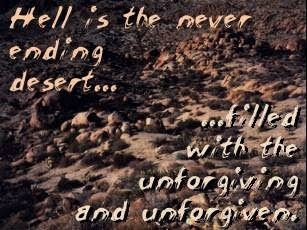
Someone says something offensive or does something unethical and is called on it. The offender realizes his or her error and offers a sincere, specific, public apology. The person might also be fired or resign. "Not good enough!" the offended party cries.
What exactly do you want? You want the person who offended you to be totally abased, to be publicly humiliated, to lose everything he owns, to never have an opportunity to gain it back, and, ultimately, to die by stoning, followed by the body being burned in the public square. There. Satisfied?
Is that the American way? It certainly isn't Christ's way.
We all have sinned and fall short of the glory of God. Those of us who have accepted Jesus as our savior have received eternal forgiveness for all our sins -- past present and future, no matter how heinous. By Christ's death on the cross, our debt is paid in full. How then can we who have been forgiven of so much be so unforgiving? How can we who enjoy such abundant grace offer no grace to our neighbors who are just like us?
Punishment has to fit the crime. Penalties have to have limits. At some point the creditor has to stamp the promissory note "Paid in Full." Refusal to do so places the unforgiving creditor in a position of superiority to God, a sin far greater than the original offense. How dare the forgiven not forgive?
We live in an age of hatred, rage and unforgiveness, and I believe this attitude holds us back as a society and as a nation.We're all human. We all make mistakes. We all screw up. We all hurt someone sometime. And a few of us commit crimes.
We have a system in this country wherein a person who commits a crime is tried in public by a presumably impartial jury; if the person is convicted, he or she receives punishment proportionate to the crime, according to law. When the sentence is completed, the convicted person can go on with his or her life.
But that doesn't seem to be good enough for an awful lot of people. At a gut level, they want more. They want blood. And they never, ever want someone who has committed a crime to stop suffering consequences for it.
Look at Michael Vick. I'm not a big fan of pro football, and I don't think athletes or celebrities deserve any special treatment. I also am an animal lover. I cry at those Sarah McLaughlin Humane Society commercials.
What Vick did was horrible and disgusting. Dogfighting is vile, ugly and inhumane. I believe it offends God.
But we have laws to deal with dogfighting, and Vick was tried and punished according to those laws. He admitted his guilt, he did his time, and he paid his debt to society -- a debt that society (that's you and me) determined.
So why doesn't that settle it? Why can't people accept a "Paid in Full" stamp on Vick's rap sheet? Why do they want him banned from the NFL, banned from society, banned from making a living for the rest of his life?
Why are the provisions of the law not good enough for people who are mad at someone for breaking the law? It's as if we agree to sell someone a car for $5,000, they pay the $5,000, and after they've driven off we tell everyone they stole the car from us. "No, what I meant was I wanted them to pay me $5,000 every day for the rest of their life."
Many, if not most, companies won't hire anyone with a felony record, even if that person has fulfilled all the court's requirements for punishment and compensation. A former boss of mine once cackled over a job application on which the applicant checked "Yes" in response to the question "Have you ever been convicted of a felony?" "This guy is too stupid to get a job," the boss told me. I guess he would have preferred for the applicant to lie.
Even when the offense doesn't rise to the level of lawbreaking, no response by the offender ever seems adequate for the offended.
Someone says something offensive or does something unethical and is called on it. The offender realizes his or her error and offers a sincere, specific, public apology. The person might also be fired or resign. "Not good enough!" the offended party cries.What exactly do you want? You want the person who offended you to be totally abased, to be publicly humiliated, to lose everything he owns, to never have an opportunity to gain it back, and, ultimately, to die by stoning, followed by the body being burned in the public square. There. Satisfied?
Is that the American way? It certainly isn't Christ's way.
We all have sinned and fall short of the glory of God. Those of us who have accepted Jesus as our savior have received eternal forgiveness for all our sins -- past present and future, no matter how heinous. By Christ's death on the cross, our debt is paid in full. How then can we who have been forgiven of so much be so unforgiving? How can we who enjoy such abundant grace offer no grace to our neighbors who are just like us?
Punishment has to fit the crime. Penalties have to have limits. At some point the creditor has to stamp the promissory note "Paid in Full." Refusal to do so places the unforgiving creditor in a position of superiority to God, a sin far greater than the original offense. How dare the forgiven not forgive?
Subscribe to:
Posts (Atom)


