God of grace and God of glory, on thy people pour thy power;
Crown thy ancient Church's story; Bring her bud to glorious flower.
Grant us wisdom, grant us courage for the facing of this hour,
For the facing of this hour.
Lo! the hosts of evil round us scorn thy Christ, assail his ways!
Fears and doubts too long have bound us; Free our hearts to work and praise.
Grant us wisdom, grant us courage for the living of these days,
For the living of these days.
Cure thy children's warring madness, bend our pride to thy control.
Shame our wanton, selfish gladness, rich in things and poor in soul.
Grant us wisdom, grant us courage lest we miss thy kingdom's goal,
Lest we miss thy kingdom's goal.
Set our feet on lofty places; gird our lives that they may be
Armored with all Christ-like graces in the fight to set men free.
Grant us wisdom, grant us courage that we fail not man nor thee,
That we fail not man nor thee.
Save us from weak resignation to the evils we deplore.
Let the search for thy salvation be our glory evermore.
Grant us wisdom, grant us courage serving thee whom we adore,
Serving thee whom we adore.
Amen.
Words by Harry Emerson Fosdick, 1878-1969
Published in The Methodist Hymnal, 1964 edition.
To read or hear the sermon that inspired this post, click here.
Monday, July 27, 2015

Saturday, September 13, 2014
May we not be of one heart?
As we continue our never-ending journey of spiritual discovery, My Lovely Wife and I joined a new Sunday school class last week that, for now at least, is studying the foundations of the United Methodist Church. We are reading a book called Revival: Faith as Wesley Lived It by pastor and theologian Adam Hamilton. (Nashville: Abingdon Press, 2014)
In the first chapter, we learn about John Wesley, the founder of Methodism, his family background in the context of 18th-century British religious and political history, and the beginnings of his path and ministry.
One particular passage struck a chord with me. Rather than tell you about it, I will quote it here at length:
What do you think?
In the first chapter, we learn about John Wesley, the founder of Methodism, his family background in the context of 18th-century British religious and political history, and the beginnings of his path and ministry.
One particular passage struck a chord with me. Rather than tell you about it, I will quote it here at length:
In his introduction to Explanatory Notes upon the New Testament, Wesley wrote these words that capture his spirit so well:"Would to God that all the party names and unscriptural phrases and forms which have divided the Christian world were forgot; and that we might all agree to sit down together as humble, loving disciples, at the feet of our common Master, to hear his word, to imbibe his Spirit, and to transcribe his life in our own!"
In one of his most famous sermons, "Catholic Spirit," Wesley wrote, "Though we can't think alike, may we not love alike? May we not be of one heart, though we are not of one opinion? Without all doubt, we may." Wesley was calling his hearers to listen to those with whom they disagreed and to focus on what they shared in common. He was teaching them (and us!) to build bridges rather than walls. The word catholic is a bit confusing to some, but in this context it simply means "universal." It conveys the sense that the church, the body of Christ, is made up not only of people who are in my denomination or tribe but of all who call upon the name of Christ, even if they disagree on this or that point of doctrine.The twenty-first century is as polarized as eighteenth-century England. We're not Tories and Whigs, conformists and dissenters, Anglicans and Puritans; we're Republicans and Democrats, fundamentalists and progressives, liberals and conservatives. Yet divisiveness and conflict drain us of our spiritual vitality and leave many today longing for a different approach, an approach like Wesley's catholic spirit.How do we embrace such an approach today? Paul described it when he admonished the believers in Philippi, who themselves were divided, "Do nothing from selfish ambition or conceit, but in humility regard others as better than yourselves. Let each of you look not to your own interests, but to the interests of others. Let the same mind be in you that was in Christ Jesus" (Philippians 2:3-5). To the Christians at Corinth, who also were deeply divided, Paul noted that love was the defining characteristic of Christian life, and then he went on to describe the character of Christian love: "Love is patient; love is kind; love is not envious or boastful or arrogant or rude. It does not insist on its own way; it is not irritable or resentful; it does not rejoice in wrongdoing, but rejoices in the truth. It bears all things, believes all things, hopes all things, endures all things" (1 Corinthians 13:4-7).Having a spirit like Wesley's today means that we assume the best of others, not the worst. We give them the benefit of the doubt. We speak well of others, not poorly. We treat them as we hope to be treated. We listen more and talk less. We walk in other people's shoes and try to understand what they believe and why. This does not mean we give up our convictions, but it does mean we test them. I've found that, after listening to another person's point of view, some ideas I was sure of were not nearly so convincing. I've found that, on more than one occasion, views that seemed utterly indefensible actually were quite convincing when I moved beyond my assumptions and took the time to listen.I've also learned that it's easy to be adamantly opposed to a viewpoint or position -- be it theological, ethical, or political -- when no one I deeply care about holds such views. But as I get to know those with views different from my own and come to care about them and consider them my friends, it is hard to be adamantly opposed to their views.Among the defining characteristics of the Christian life are humility, grace, and love. The test of our faith comes in how we respond to others and how willing we are to listen to, learn from, and love them.
What do you think?
Tuesday, August 12, 2014
I'm no Robin Williams, but ...
 |
| Los Angeles Times |
Some people think I'm pretty funny. Much of the time, I am one of those people.
Maybe that's why Robin Williams' suicide has hit me so hard.
Many of my friends and even members of my own family probably don't know this, but I have suffered from depression, at times severe, since I was about 12 years old. It wasn't diagnosed until I was 32. Before and since then, it has caused upheaval in my life, skewing my thinking and hampering my ability to make good decisions. If My Lovely Wife were not a superhero, it would have killed our marriage long ago.
It has come close to killing me more than once. I've never attempted suicide, but during the blackest, foggiest passages of the abyss I have contemplated and even planned it. The irony is that the depression robbed me of the initiative to go through with it.
It pisses me off because at various times I have thought I was free of this depression, but it always comes back.
About three years ago I tumbled into one of the deepest, darkest emotional pits I've ever known. I could barely function; somehow, by the grace of God, I managed not to get fired from my job during this period. I had daily panic attacks, and I couldn't hold my bladder. I thought about death, obsessively, every day for months -- usually in a positive light.
Thank God I was able to ask for help. An attentive and compassionate doctor put me on a particular medication, but it had no effect. We switched to a different drug, and almost immediately I started showing symptoms of mania.
I was freaking out, believing that I was slipping down a well-greased slope to full-on psychosis. I didn't want to be that nice, smart, funny guy who went crazy and spent the rest of his life as a friendless, homeless lunatic bothering people on the train. As my irrational mind reasoned it out, it seemed better to me to go to my eternal rest than to spend my remaining years as an object of pity and horror.
That's when the miracle happened. Miracle, thy name is Prozac.
 I know Prozac (fluoxetine) has gotten a fair amount of bad press over the years, but I can tell you in no uncertain terms: Prozac saved my life. Now I take a fairly hefty dose of it every morning, paired with timed doses of Buspar (buspirone) that help keep me on an even keel throughout the day.
I also have been seeing a therapist on a regular basis. For a while, just last year, I was placed in intensive (outpatient) therapy, where I met a number of other people who were struggling as I was, each in his or her own way. These were private battles, but we were all in it together, and somehow that was comforting.
And now, with these therapies and after making some desperately needed changes in my life, I am happier and healthier than I've been in a very long time. What had seemed impossible has become my daily reality. I'm me again.
When one drug or therapy or therapist doesn't work for you, it doesn't mean you're beyond help; it simply means that particular drug or therapy or therapist doesn't work for you at this time. There are plenty out there, and it's worth trying out as many as necessary to find one that helps you start feeling normal again.
And that's a key understanding: These are not "happy pills" that artificially raise your mood and turn you into a grinning idiot; they are chemotherapy that kills the cancer of depression that makes you feel abnormally bad. They pull you back to normal.
I had forgotten what normal was. Although I was still quick with a comeback or a one-liner or a wry Facebook comment, I had forgotten what joy and peace felt like. I thought -- I really believed -- they were lost to me forever.
That's the lie that depression tells you, over and over again like the relentless beat of house music: It's never going to get better; things will always be the way they are right now, or worse; there is no hope.
But that's a lie straight out of the pits of hell. ("He [the devil] was a murderer from the beginning and does not stand in truth, because there is no truth in him. When he tells a lie, he speaks in character, because he is a liar and the father of lies." John 8:44b)
There is hope, even if you can't see it right now. Fight for your life. As the poet Charles Bukowski wrote, "Your life is your life. Don't let it be clubbed into dank submission. Be on the watch: There are ways out. There is light somewhere."
If you feel profoundly sad, or hopeless, or angry, or listless, or confused, or forgotten, or lonely, or worthless, or anxious, please, please, talk to someone. Talk to someone who will listen, someone who is willing to walk alongside you on the winding path to getting better. These feelings seem completely real, but they are not normal, they are not right, and there are ways out.
I'm testimony -- living testimony -- to that.
I am heartbroken for Robin Williams and for those who loved him. But I am grateful for the many gifts he gave us, not least of which was an opening for this conversation.
Beloved, seek peace and pursue it. "You are marvelous; the gods wait to delight in you."
Thursday, May 15, 2014
Goodbye and welcome

Barring a spectacular miracle of God, there is soon going to be a death in my family. My heart breaks over it. Too young. Too soon. Too painful. Too unfair. Too much.
Yet we do not grieve in the same way as those who have no hope. Because I believe in God and believe his word, I believe we are eternal beings, and the time we spend in what we call life is merely a passage on a never-ending journey. From the eternal perspective, death is not the bold demarcation line we make it out to be. It is merely a transition from one phase of eternity to the next. Grievously painful for those of us who are left behind and who will miss our loved one for the rest of our earthly lives, but a joyous graduation for the one making the transition.
A friend recently gave me the book Come Thirsty by Max Lucado (2004, W Publishing Group, Nashville, TN). One chapter in particular, titled "When Death Becomes Birth," has been a great comfort to me as I sadly await the inevitable news from my hometown. Here is an excerpt:
You, as all God's children, live one final breath from your own funeral.
Which, from God's perspective, is nothing to grieve. He responds to these grave facts with this great news: "The day you die is better than the day you are born" (Ecclesiastes 7:1). Now there is a twist. Heaven enjoys a maternity-ward reaction to funerals. Angels watch body burials the same way grandparents monitor delivery room doors. "He'll be coming through any minute!" They can't wait to see the new arrival. While we're driving hearses and wearing black, they're hanging pink and blue streamers and passing out cigars. We don't grieve when babies enter the world. The hosts of heaven don't weep when we leave it. ...
Your death may surprise you and sadden others, but heaven knows no untimely death: "You saw me before I was born. Every day of my life was recorded in your book. Every moment was laid out before a single day had passed" (Psalm 139:16). ...
For all who doubt his power, Jesus has three words: "Lazarus, come out!" (John 11:43). ...
Heaven-happy Lazarus doesn't question the call. Perfect understanding comes with a heavenly passport. He doesn't object. But had he done so, who could have faulted him? His heavenly body knows no fever. His future knows no fear. He indwells a city that is void of padlocks, prisons, and Prozac. ... Would anyone blame Lazarus for saying, "Do I have to go back?"
But he doesn't second-guess the command. ... With a wave and within a wink, he's reunited with his body and waking up on a cold slab in a wall-hewn grave. ...
We read and may ask, "Why did Jesus let him die only to call him back?"
To show who runs the show. To trump the cemetery card. To display the unsquashable strength of the One who danced the Watusi on the neck of the devil, who stood face to clammy face with death and declared, "You call that a dead end? I call it an escalator."
"Lazarus, come out!"
These words, incidentally , were only a warmup for the the big day. He's preparing a worldwide grave evacuation. "Joe, come out!" "Maria, come out!" ("Bridget, come out!" "Matthew, come out!" "Jack, come out!" "Honey, come out!" "David, come out!" "Ruth, come out!" "Jason, come out!" - Ed.) Grave after grave will empty. What happened to Lazarus will happen to us. ...
When this happens -- when our perishable earthly bodies have been transformed into heavenly bodies that will never die -- then at last the Scriptures will come true:
"Death is swallowed up in victory.
O death, where is your victory?
O death, where is your sting?"
(1 Corinthians 15: 54-55)
Till then, where does that leave us? It leaves us checking our list of friends. Because Lazarus called Jesus his friend, Jesus called Lazarus from the grave. ...
Dread of death ends when you know heaven is your true home.
Yes, we grieve, as we should. We are going to miss our loved one, and mourn for what might have been done with a few more years. But our grief is soothed by the balm of hope.
Sunday, December 8, 2013
Fly away, Earle Bird

Of the six cats we've had, Earle was the only one who introduced herself by name.
Sometime before 2006, My Lovely Wife had become telephone friends with a woman in Hillsdale, Michigan, with whom she played online games, but they had never met in person. The woman's name was Earle (pronounced "Early"), apparently because her father had wanted a boy. (Her sisters' names were Winifred and Honora; it's best not to ask too many questions.)
Earle lived alone in a little apartment with her cat, Prissy. Earle was obese, she smoked a lot, and she was in generally poor health. Prissy and the Internet were just about all she had. One day when they were chatting, Earle told MLW that she was planning to have Prissy put to sleep should anything happen to Earle, because she didn't know who in the world would take her in and give her the kind of attention to which she was accustomed.
"That's crazy," MLW told her. "I'll take your cat if anything happens to you."
"You promise?"
"I promise."

Monday, December 2, 2013
Gracism in Georgia

Caroline, Caroline, God claims you, God helps you, protects you, and loves you too.
We this day do all agree a child of God you'll always be.
Caroline, Caroline, God claims you, God helps you, protects you, and loves you too.
We your family love you so, we vow to help your faith to grow.
Caroline, Caroline, God claims you, God helps you, protects you, and loves you too.
We are here to say this day that we will help you on your way.
Caroline, Caroline, God claims you, God helps you, protects you, and loves you too.
And if you should tire or cry, then we will sing this lullaby.
Caroline, Caroline, God claims you, God helps you, protects you, and loves you too.
I'm new to the Methodist tradition, so I don't know if this is standard baptism procedure. Regardless, it was beautiful and touching.
After the service ended, I walked through the narthex to say hello to the pastor in the open doorway before heading home. Dalton said he had a book for me and asked me to wait a few minutes while he finished greeting folks, so I stepped out onto the church's large concrete porch in the autumn warmth.
A tall, well-presented young man was standing just behind and to Dalton's left on the porch. The young man immediately greeted me with a firm handshake and a smile and introduced himself as George. He was clean-shaven, had a conservative but attractive haircut under a navy blue ball cap, and flashed a set of perfectly straight, perfectly white teeth. He was impressive. I guessed he was in his early 20s.
We exchanged polite small talk as people continued to file out of the church. Because I am new to this church and still haven't met many people, I asked George if he attended there regularly.
"No sir," he responded earnestly. "Actually, I'm homeless and I was waiting right over there for the bus, but I needed to use the bathroom so I came into the church."
I tried not to look as stunned as I felt as he continued his matter-of-fact description of his day so far:
Monday, October 28, 2013
Dreams do come true
 |
| I bought a bottle of wine in Paris 10 years ago, and decided not to open it until the day I went to work for the Carter Center. Today was that day. |
I am so grateful to God for working this out, and to the many of you who supported me and my dream over the years through your prayers and encouragement.
My first article for the center was published on its blog today. (If you wish to read it in the context of the blog, click on the headline. That would be good for traffic too. Just saying.)
Carter Center Pursues Lasting Peace in the Sudans
By The Carter Center
Disputes over borders, an oil pipeline and access to resources persist in Sudan and South Sudan, which separated into distinct republics in 2011 after decades of civil war. But The Carter Center, which helped broker the 2005 peace agreement, has never stopped guiding the parties toward harmonious coexistence.
At the October 15 event, Jok and the Republic of Sudan’s Ambassador Nureldin Satti sat side by side, often calling one another “brother.”
Sudan is “a rainbow nation, a microcosm of Africa,” Satti said. The civil war and subsequent division was “a failure,” he said, but “Sudan is one people in two countries. … We belong to each other.”
Saturday, October 19, 2013
Time marches upward
 |
| © Heike Jestram |
Wooden ladders.
For thousands of years, wooden ladders were the best technology available for getting from the ground to the top of a wall. There were very few convenient, affordable options, and wooden ladders were easy to make out of readily available materials.
But then someone figured out how to make stuff out of aluminum, and someone later figured out how to do that cheaply, and someone later yet figured out a really good design for a ladder made of aluminum.
Unlike wooden ladders, aluminum ladders don't rot, don't break easily, and are lightweight for carrying and storage.
Consumers recognized the benefits of aluminum over wood and spent their money accordingly. And the next thing you know -- no more wooden ladders.
Sure, we still love the idea and the aesthetic of a wooden ladder -- I mean, come on, look at that picture above -- but the vast majority of consumers would choose aluminum over wood every time (if wood were even a real option). The technology is simply better, and those who insisted on sticking with the old technology fell behind and went out of business or became boutique operations.
You know what else you almost never see anymore?
Sunday, September 29, 2013
A poem for our times -- from 1922
Part of this poem was read at the church service we visited today. I like it a lot. It was written by Edith Nesbit (British, 1858-1924), considered the first modern children's author ("The Enchanted Castle," "The Railway Children," "Three Children and It").
Note: "Dives" is a traditional name for the rich man in Jesus' parable of the rich man and Lazarus in Luke 16. It is pronounced "DIE-vez."
We do not clamour for vengeance,
We do not whine for fear;
We have cried in the outer darkness
Where was no man to hear.
We cried to man and he heard not;
Yet we thought God heard us pray;
But our God, who loved and was sorry -
Our God is taken away.
Ours were the stream and the pasture,
Forest and fen were ours;
Ours were the wild wood-creatures,
The wild sweet berries and flowers.
You have taken our heirlooms from us,
And hardly you let us save
Enough of our woods for a cradle,
Enough of our earth for a grave.
Note: "Dives" is a traditional name for the rich man in Jesus' parable of the rich man and Lazarus in Luke 16. It is pronounced "DIE-vez."
 |
| www.edithnesbit.co.uk |
"The Stolen God -- Lazarus to Dives" by Edith Nesbit
We do not clamour for vengeance,
We do not whine for fear;
We have cried in the outer darkness
Where was no man to hear.
We cried to man and he heard not;
Yet we thought God heard us pray;
But our God, who loved and was sorry -
Our God is taken away.
Ours were the stream and the pasture,
Forest and fen were ours;
Ours were the wild wood-creatures,
The wild sweet berries and flowers.
You have taken our heirlooms from us,
And hardly you let us save
Enough of our woods for a cradle,
Enough of our earth for a grave.
Thursday, September 19, 2013
Go team!

It seems almost quaint today, but in its time, the TV sitcom Seinfeld broke new ground in the way it addressed how straight people misunderstand gays and lesbians. In a 1995 episode titled "The Beard," Elaine decides she wants to start dating an attractive man she knows. Only problem: He's gay. Undaunted, Elaine has a plan. She talks it over with Jerry at the coffee shop:*
Jerry: Not conversion. You're thinking conversion?
Elaine: Well, it did occur to me.
Jerry: You think you can get him to just change teams? He's not going to suddenly switch sides. Forget about it.
Elaine: Why? Is it irrevocable?
Jerry: Because when you join that team it's not a whim. He likes his team. He's set with that team.
Elaine: We've got a good team.
Jerry: Yeah, we do. We do have a good team.
Elaine: Why can't he play for us?
Jerry: They're only comfortable with *their* equipment.
Elaine: We just got along *so* great.
Jerry: Of course you did. Everyone gets along great when there's no possibility of sex.
Elaine: No, no, no, I sensed something. I did sense something. I perceived a possibility, Jerry.
Jerry: You realize you're venturing into uncharted waters.
Elaine: I realize that.
Jerry: Are you that desperate?
Elaine: Yes I am.
Thursday, May 30, 2013
Here's to you, Mr. Robinson

Recently I've been rediscovering some of the ancient baseball books on my bookshelf. "Baseball Stars of 1965" comprises profiles of a number of memorable (Hank Aaron, Al Kaline, Mickey Mantle) and not-so-memorable (Juan Pizarro? Wally Bunker??) players.
But the one that stood out for me was that of Frank Robinson. Turns out he and I have a lot in common. For one, he is the youngest of 11 children, as am I.
OK, so that's the only thing we have in common.
Still, I was touched by his story of being misunderstood and underrated for the first nine years of his career, despite putting up numbers that would eventually pave his way to Cooperstown. The writer was both empathetic and critical, and the article prompted me to write the following letter to Mr. Robinson:
Wednesday, December 19, 2012
I been knowin' it

If you know me, you know I'm a pretty fervent believer in Jesus Christ. What you may not know is that Sister Dorothy Johnson, who graduated to heaven last weekend, has been one of the greatest influences on my relationship with my Savior.
Soon after my salvation experience (another story for another time), Roxanna and I joined The House of the Lord, where Pastor Dennis Butts Sr. invited us to join a Wednesday noon care group. There we became part of a family that included Pastor Butts, Sis. Lucille Henley, Michelle Bender, Mary Bianconi, David Benson, Sis. Joyce Finley-Jackson, Sis. Pat Murray, and this scrawny little VA nurse who was always the first to arrive.
Wednesday, December 5, 2012
Every time a bell rings ...
 |
Let me explain.
Ever since I was about 12 years old, I have suffered periodic bouts of depression. It was never diagnosed until I was in my 30s. Toward the end of 2009 it came back with a vengeance, and I've been praying, working and medicating to fight it off ever since.
They say that significant life events can trigger depressive episodes, and like anyone, I'd had my share of those in recent times: a job change; a big move; a serious health scare; the death of a close friend; the sickness and death of my father-in-law; the death of a pet; a separation from my beloved goddaughter; a difficult relationship with a supervisor; witnessing a series of disasters. Any one or two of these would have been plenty, thank you.
Many of those things just have to be grieved, and that is simply a function of time and allowing yourself to feel your feelings. (The best thing anyone said to me after my mother died in 1998 came from my close friend Tony, who said, "Just feel what you feel, man. Feel what you feel.")
 |
| © Liberty Films |
It's a hard life being at once a Christian, an optimist, a liberal and a journalist. You want to see and hope for the best in people and society, but the evidence to the contrary is overwhelming. You trust in a loving and benevolent God, but you witness daily a corrupt and hateful world. You feel strongly motivated to reach out and help "the least of these," but the sheer quantity of them is paralyzing.
War, crime, cruelty, hatred, selfishness, greed, wastefulness, irresponsibility -- all of these are failings of humanity and are to be expected because we are a fallen race. That doesn't mean we have to like them, or accept them, or even overcome them. One thing we can do is pray for humanity, pray that the light of God's love will drive out the darkness of the world. It's frustrating to realize that this change has to happen one soul at a time.
Friday, November 30, 2012
Aaaaand ... we're back
Well hello!
After a three-year hiatus, I'm blogging again. I used to write a blog called The Freakin' Deacon; I've imported all of that blog's content to this one so you can find all my foolish ramblings in one place.
 The purpose of the original blog was to chronicle my journey through what was shaping up to be a long, drawn-out health challenge having to do with some anomalous blood tests. If you follow the old posts, you'll see that all turned out fine, thanks to your prayers and God's grace.
I quit blogging three years ago because of two primary factors: First, I had discovered Facebook and found it to be much more satisfying because of the interactive element. I got immediate reactions to things I wrote, I seemed to be reaching a much larger audience, and I liked the way it allowed me to connect with people I might never encounter otherwise. All of this is still true, but a blog may be a better format for expressing some things that cross my mind. In other words, I can write longer here.
Second, and probably more important, toward the end of 2009 (when I stopped blogging) I fell into a precipitous spiral of depression and anxiety that nearly destroyed me. This illness severely affected my job performance, and I came dangerously close to losing my job before I got help.
I'm not clear of this sickness yet, but I am much, much better now than I have been at any time since this all began. On those days when the depression is at its worst, I feel as if I'm enveloped in a thick fog that clouds my vision, my hearing, my thinking and my feeling. Nothing makes sense, and I can see no solutions.
Yet through it all, perhaps because I've been through it before, I've remained confident in the Lord my God, that through the sacrifice of Jesus the Christ, the ministry of the Holy Spirit and the overwhelming, overcoming love of my wife and others among God's people, I would eventually emerge from this victorious.
That's the genesis of the new name of this blog. I'm still experiencing that fog occasionally, but even on those dark days I know someone loves me, someone is pulling for me, someone is keeping me from drowning. I know deep down inside that I have another, greater F.O.G. -- the Favor of God.
In addition, I no longer am a member of the church where I was a deacon, so the name didn't fit anymore for that reason too. (I am an usher at my current church, but "Ushering in the fog" just didn't work for me.)
I want to thank several women in my life who have helped make my blog resurrection possible. First and foremost is My Lovely Wife, Roxanna, who has been unfailingly steadfast in her love, compassion and understanding through this entire ordeal. I love you so much. I also want to thank my sister Sheila, who has taken up the torch from our mother and frequently urges me to keep writing. Thanks also to friend and colleague Sari Zeidler, who brainstormed possible blog names with me. And thanks to CNN writers Stephanie Gallman and Kat Kinsman, whose brave writings about their own depression have encouraged me to accept mine for what it is and emboldened me to be transparent about it.
I hope you find this new blog to be interesting, thought-provoking, encouraging, and sometimes funny.
I also hope it doesn't take another three years to come up with my next topic.
After a three-year hiatus, I'm blogging again. I used to write a blog called The Freakin' Deacon; I've imported all of that blog's content to this one so you can find all my foolish ramblings in one place.

I quit blogging three years ago because of two primary factors: First, I had discovered Facebook and found it to be much more satisfying because of the interactive element. I got immediate reactions to things I wrote, I seemed to be reaching a much larger audience, and I liked the way it allowed me to connect with people I might never encounter otherwise. All of this is still true, but a blog may be a better format for expressing some things that cross my mind. In other words, I can write longer here.
Second, and probably more important, toward the end of 2009 (when I stopped blogging) I fell into a precipitous spiral of depression and anxiety that nearly destroyed me. This illness severely affected my job performance, and I came dangerously close to losing my job before I got help.
I'm not clear of this sickness yet, but I am much, much better now than I have been at any time since this all began. On those days when the depression is at its worst, I feel as if I'm enveloped in a thick fog that clouds my vision, my hearing, my thinking and my feeling. Nothing makes sense, and I can see no solutions.
Yet through it all, perhaps because I've been through it before, I've remained confident in the Lord my God, that through the sacrifice of Jesus the Christ, the ministry of the Holy Spirit and the overwhelming, overcoming love of my wife and others among God's people, I would eventually emerge from this victorious.
That's the genesis of the new name of this blog. I'm still experiencing that fog occasionally, but even on those dark days I know someone loves me, someone is pulling for me, someone is keeping me from drowning. I know deep down inside that I have another, greater F.O.G. -- the Favor of God.
In addition, I no longer am a member of the church where I was a deacon, so the name didn't fit anymore for that reason too. (I am an usher at my current church, but "Ushering in the fog" just didn't work for me.)
I want to thank several women in my life who have helped make my blog resurrection possible. First and foremost is My Lovely Wife, Roxanna, who has been unfailingly steadfast in her love, compassion and understanding through this entire ordeal. I love you so much. I also want to thank my sister Sheila, who has taken up the torch from our mother and frequently urges me to keep writing. Thanks also to friend and colleague Sari Zeidler, who brainstormed possible blog names with me. And thanks to CNN writers Stephanie Gallman and Kat Kinsman, whose brave writings about their own depression have encouraged me to accept mine for what it is and emboldened me to be transparent about it.
I hope you find this new blog to be interesting, thought-provoking, encouraging, and sometimes funny.
I also hope it doesn't take another three years to come up with my next topic.
Monday, August 17, 2009
A culture of unforgiveness
Why can't we forgive in this country? And why, if we brag that this is such a great country, don't we believe in one of the things that set it apart: our justice system?
 We live in an age of hatred, rage and unforgiveness, and I believe this attitude holds us back as a society and as a nation.
We're all human. We all make mistakes. We all screw up. We all hurt someone sometime. And a few of us commit crimes.
We have a system in this country wherein a person who commits a crime is tried in public by a presumably impartial jury; if the person is convicted, he or she receives punishment proportionate to the crime, according to law. When the sentence is completed, the convicted person can go on with his or her life.
But that doesn't seem to be good enough for an awful lot of people. At a gut level, they want more. They want blood. And they never, ever want someone who has committed a crime to stop suffering consequences for it.
Look at Michael Vick. I'm not a big fan of pro football, and I don't think athletes or celebrities deserve any special treatment. I also am an animal lover. I cry at those Sarah McLaughlin Humane Society commercials.
What Vick did was horrible and disgusting. Dogfighting is vile, ugly and inhumane. I believe it offends God.
But we have laws to deal with dogfighting, and Vick was tried and punished according to those laws. He admitted his guilt, he did his time, and he paid his debt to society -- a debt that society (that's you and me) determined.
So why doesn't that settle it? Why can't people accept a "Paid in Full" stamp on Vick's rap sheet? Why do they want him banned from the NFL, banned from society, banned from making a living for the rest of his life?
Why are the provisions of the law not good enough for people who are mad at someone for breaking the law? It's as if we agree to sell someone a car for $5,000, they pay the $5,000, and after they've driven off we tell everyone they stole the car from us. "No, what I meant was I wanted them to pay me $5,000 every day for the rest of their life."
Many, if not most, companies won't hire anyone with a felony record, even if that person has fulfilled all the court's requirements for punishment and compensation. A former boss of mine once cackled over a job application on which the applicant checked "Yes" in response to the question "Have you ever been convicted of a felony?" "This guy is too stupid to get a job," the boss told me. I guess he would have preferred for the applicant to lie.
Even when the offense doesn't rise to the level of lawbreaking, no response by the offender ever seems adequate for the offended.
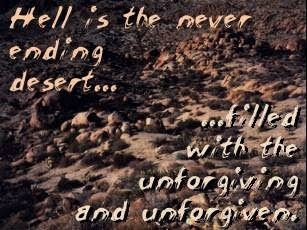 Someone says something offensive or does something unethical and is called on it. The offender realizes his or her error and offers a sincere, specific, public apology. The person might also be fired or resign. "Not good enough!" the offended party cries.
What exactly do you want? You want the person who offended you to be totally abased, to be publicly humiliated, to lose everything he owns, to never have an opportunity to gain it back, and, ultimately, to die by stoning, followed by the body being burned in the public square. There. Satisfied?
Is that the American way? It certainly isn't Christ's way.
We all have sinned and fall short of the glory of God. Those of us who have accepted Jesus as our savior have received eternal forgiveness for all our sins -- past present and future, no matter how heinous. By Christ's death on the cross, our debt is paid in full. How then can we who have been forgiven of so much be so unforgiving? How can we who enjoy such abundant grace offer no grace to our neighbors who are just like us?
Punishment has to fit the crime. Penalties have to have limits. At some point the creditor has to stamp the promissory note "Paid in Full." Refusal to do so places the unforgiving creditor in a position of superiority to God, a sin far greater than the original offense. How dare the forgiven not forgive?
 We live in an age of hatred, rage and unforgiveness, and I believe this attitude holds us back as a society and as a nation.
We're all human. We all make mistakes. We all screw up. We all hurt someone sometime. And a few of us commit crimes.
We have a system in this country wherein a person who commits a crime is tried in public by a presumably impartial jury; if the person is convicted, he or she receives punishment proportionate to the crime, according to law. When the sentence is completed, the convicted person can go on with his or her life.
But that doesn't seem to be good enough for an awful lot of people. At a gut level, they want more. They want blood. And they never, ever want someone who has committed a crime to stop suffering consequences for it.
Look at Michael Vick. I'm not a big fan of pro football, and I don't think athletes or celebrities deserve any special treatment. I also am an animal lover. I cry at those Sarah McLaughlin Humane Society commercials.
What Vick did was horrible and disgusting. Dogfighting is vile, ugly and inhumane. I believe it offends God.
But we have laws to deal with dogfighting, and Vick was tried and punished according to those laws. He admitted his guilt, he did his time, and he paid his debt to society -- a debt that society (that's you and me) determined.
So why doesn't that settle it? Why can't people accept a "Paid in Full" stamp on Vick's rap sheet? Why do they want him banned from the NFL, banned from society, banned from making a living for the rest of his life?
Why are the provisions of the law not good enough for people who are mad at someone for breaking the law? It's as if we agree to sell someone a car for $5,000, they pay the $5,000, and after they've driven off we tell everyone they stole the car from us. "No, what I meant was I wanted them to pay me $5,000 every day for the rest of their life."
Many, if not most, companies won't hire anyone with a felony record, even if that person has fulfilled all the court's requirements for punishment and compensation. A former boss of mine once cackled over a job application on which the applicant checked "Yes" in response to the question "Have you ever been convicted of a felony?" "This guy is too stupid to get a job," the boss told me. I guess he would have preferred for the applicant to lie.
Even when the offense doesn't rise to the level of lawbreaking, no response by the offender ever seems adequate for the offended.
 Someone says something offensive or does something unethical and is called on it. The offender realizes his or her error and offers a sincere, specific, public apology. The person might also be fired or resign. "Not good enough!" the offended party cries.
What exactly do you want? You want the person who offended you to be totally abased, to be publicly humiliated, to lose everything he owns, to never have an opportunity to gain it back, and, ultimately, to die by stoning, followed by the body being burned in the public square. There. Satisfied?
Is that the American way? It certainly isn't Christ's way.
We all have sinned and fall short of the glory of God. Those of us who have accepted Jesus as our savior have received eternal forgiveness for all our sins -- past present and future, no matter how heinous. By Christ's death on the cross, our debt is paid in full. How then can we who have been forgiven of so much be so unforgiving? How can we who enjoy such abundant grace offer no grace to our neighbors who are just like us?
Punishment has to fit the crime. Penalties have to have limits. At some point the creditor has to stamp the promissory note "Paid in Full." Refusal to do so places the unforgiving creditor in a position of superiority to God, a sin far greater than the original offense. How dare the forgiven not forgive?
Sunday, August 16, 2009
Is there not a cause?
My brilliant pastor, Jentezen Franklin, this morning preached on the subject, "You need to get free of 'What's in it for me?'" He used the passage in 1 Samuel 17 where David's brothers and other men tell David what rewards would be given to the man who slays Goliath.
These guys were all focused on the prizes -- great riches, the king's daughter in marriage, and tax-free living for life. But all that talk didn't sit well with David, who said, "Is there not a cause?"
By that David meant there was a better reason than personal rewards to go after Goliath. This thug was insulting their God and everyone who believed in him. What more incentive did they need?
My pastor then lit into preachers who do things not for the glory of God and furtherance of his kingdom, but for self-aggrandizement and income opportunities. Then he turned it onto the rest of us, saying the cause of God's kingdom should be enough motivation to get us to serve others; we shouldn't need any other incentives, such as payment, recognition or fame. Amen and amen.
He kept repeating the line, "You need to get free of 'What's in it for me?'" And it got me thinking about the health-care town hall screamers and the current crop of conservatives in general. (By the way, Franklin himself is clearly pretty conservative, so this message surprised me a little, but he didn't take it where I'm about to.)
This very morning on the way to church I had been saying to My Lovely Wife that the theme of these protests makes me sick. I saw on TV a woman with a look of disgust say of President Obama's proposed plan, "It takes away from those who have been paying for health care for years [and] reduces our health care so that everyone else can have it."
Yes, and isn't that horrible? I mean, I got mine, so SCREW everybody else! Am I my brother's keeper? Why should I be expected to give up a tiny fraction of the abundance that I have so that my neighbor who has nothing might have something?
I've never really been able to put my finger on what it is about conservatives that nettles me so much, but this is it exactly: They go on and on about how great America is, America love it or leave it, God bless America, but they're not willing to give anything up to help their fellow Americans. Anyone who suggests Americans pool their resources to help out the least of these is decried as a SOCIALIST!
I wonder if any of them have ever read the last four verses of the second chapter of Acts. The first Christians were total pinkos.
I voted for Obama in the primary election, but I liked Hillary Clinton's health-care reform plan better. So I'm not suggesting everyone should just go for Obama's plan; it definitely needs work. What I am saying is that it appalls me that people think it's OK to let their fellow Americans -- even children -- go without health care.
Believe it or not, I actually liked George W. Bush for a minute when he was running for president in 2000. That line about ushering in an era of "compassionate conservatism" got my attention. But those words turned out to be not only a lie, but an oxymoron. In today's American politics, conservatism is by definition the opposite of compassionate. It is service only to oneself, regardless of the cost to others.
What's in it for me? How about a better night's sleep knowing some child won't die because her parents' insurance company didn't want to pay for a liver transplant? How about fewer people hitting you up for money while you're walking downtown because medical bills will no longer drive anyone into homelessness? How about the avoidance of a rebuke at the Judgment Seat of Christ when he says, "Inasmuch as you did it not to one of the least of these, you did it not to me."
These guys were all focused on the prizes -- great riches, the king's daughter in marriage, and tax-free living for life. But all that talk didn't sit well with David, who said, "Is there not a cause?"
By that David meant there was a better reason than personal rewards to go after Goliath. This thug was insulting their God and everyone who believed in him. What more incentive did they need?
My pastor then lit into preachers who do things not for the glory of God and furtherance of his kingdom, but for self-aggrandizement and income opportunities. Then he turned it onto the rest of us, saying the cause of God's kingdom should be enough motivation to get us to serve others; we shouldn't need any other incentives, such as payment, recognition or fame. Amen and amen.
He kept repeating the line, "You need to get free of 'What's in it for me?'" And it got me thinking about the health-care town hall screamers and the current crop of conservatives in general. (By the way, Franklin himself is clearly pretty conservative, so this message surprised me a little, but he didn't take it where I'm about to.)
This very morning on the way to church I had been saying to My Lovely Wife that the theme of these protests makes me sick. I saw on TV a woman with a look of disgust say of President Obama's proposed plan, "It takes away from those who have been paying for health care for years [and] reduces our health care so that everyone else can have it."
Yes, and isn't that horrible? I mean, I got mine, so SCREW everybody else! Am I my brother's keeper? Why should I be expected to give up a tiny fraction of the abundance that I have so that my neighbor who has nothing might have something?
I've never really been able to put my finger on what it is about conservatives that nettles me so much, but this is it exactly: They go on and on about how great America is, America love it or leave it, God bless America, but they're not willing to give anything up to help their fellow Americans. Anyone who suggests Americans pool their resources to help out the least of these is decried as a SOCIALIST!
I wonder if any of them have ever read the last four verses of the second chapter of Acts. The first Christians were total pinkos.
I voted for Obama in the primary election, but I liked Hillary Clinton's health-care reform plan better. So I'm not suggesting everyone should just go for Obama's plan; it definitely needs work. What I am saying is that it appalls me that people think it's OK to let their fellow Americans -- even children -- go without health care.
Believe it or not, I actually liked George W. Bush for a minute when he was running for president in 2000. That line about ushering in an era of "compassionate conservatism" got my attention. But those words turned out to be not only a lie, but an oxymoron. In today's American politics, conservatism is by definition the opposite of compassionate. It is service only to oneself, regardless of the cost to others.
What's in it for me? How about a better night's sleep knowing some child won't die because her parents' insurance company didn't want to pay for a liver transplant? How about fewer people hitting you up for money while you're walking downtown because medical bills will no longer drive anyone into homelessness? How about the avoidance of a rebuke at the Judgment Seat of Christ when he says, "Inasmuch as you did it not to one of the least of these, you did it not to me."
Monday, July 20, 2009
Memorable birthday
My sister Margaret had a pretty amazing 16th birthday.
In addition to the usual cake and ice cream and gifts, her party included a giant leap for mankind.
I remember all of us gathered in the family room that evening, watching the broadcast. I don't remember which network we were watching, but it was probably CBS with Walter Cronkite and Wally Schirra, because Channel 6 was the clearest station we could receive. It may have been NBC, though, because Margaret liked David Brinkley better. We were a news-watching and -reading family.
Margaret's 9-year-old brother Jim was sitting on the couch (or davenport, as we called it), craning his neck to get a better view of the upside-down image as Neil Armstrong took that momentous step. Even as a 9-year-old, I understood what a historic moment this was.
After Armstrong said, "That's one small step for man, one giant leap for mankind," I asked what that was supposed to mean. Weren't "man" and "mankind" the same thing? Even as a 9-year-old, I was a smart-alecky copy editor in the making.
A year or two later, my dad and I stood in line for four hours at the Capitol Complex in Lansing to get a glimpse of a moon rock. What an amazing time to be a little kid.
In addition to the usual cake and ice cream and gifts, her party included a giant leap for mankind.
I remember all of us gathered in the family room that evening, watching the broadcast. I don't remember which network we were watching, but it was probably CBS with Walter Cronkite and Wally Schirra, because Channel 6 was the clearest station we could receive. It may have been NBC, though, because Margaret liked David Brinkley better. We were a news-watching and -reading family.
Margaret's 9-year-old brother Jim was sitting on the couch (or davenport, as we called it), craning his neck to get a better view of the upside-down image as Neil Armstrong took that momentous step. Even as a 9-year-old, I understood what a historic moment this was.
After Armstrong said, "That's one small step for man, one giant leap for mankind," I asked what that was supposed to mean. Weren't "man" and "mankind" the same thing? Even as a 9-year-old, I was a smart-alecky copy editor in the making.
A year or two later, my dad and I stood in line for four hours at the Capitol Complex in Lansing to get a glimpse of a moon rock. What an amazing time to be a little kid.
Wednesday, July 8, 2009
The wheel of life
On this, the 90th anniversary of my mother's birth, I present a newspaper guest column I wrote 20 years ago. I believe this was my first published work after college. It ran on the front of the Metro section of the Fort Wayne (Indiana) News-Sentinel, where I was a copy editor.
Wheel of life takes emotions on a wild ride
August 16, 1989
This summer has been a matter of life and death for my family.
The season has always consisted of languorous days spent staying out of the sun and muggy evenings spent sipping iced tea on the front porch. Baseball games on the radio and the smell of ribs on the neighbors’ grill.
Come to think of it, all that stuff has been going on as usual, but other events have marked this summer, and I’m not at all comfortable with the theme.
The cycle started, like summer, on Memorial Day weekend, when my wife and I were driving on U.S. 30 to visit her brother in Chicago. It was fairly early that beautiful Saturday morning, and there was very little traffic. We were sharing cinnamon rolls we had bought at T.J. Cinnamon’s on what was supposed to be its last day in business (it has since been resurrected), getting sticky fingers and having a good time.
We both were looking out the side window at a farm where the cattle were standing near the road. We were searching the herd for calves.
When I looked to the road again, I saw in front of us a wall of steel in the form of a stopped livestock truck. Instinctively, I swerved left onto the median, missing the huge truck by little more than a few inches. After I got my pickup back on the highway, still going about 50 mph, my wife put her hand on my arm. It felt like the hand of God.
Neither of us said a word for five minutes. Later we prayed and she cried.
Apparently even as that brush with death was happening, the pathetic stray cat we had taken in on Mother’s Day was giving birth back home to five kittens.
Kittens are wonderful. They can entertain without trying, delight without cloying. We’ve tried not to get too attached to them, because we know we have to give them all away, but they’re hard to resist.
It has been a joy to watch them grow, explore, learn and play. They make you feel wonderful about life.
Now we learn one of them has a heart murmur, and we have to decide whether to “put it to sleep” (to use the prevalent euphemism for killing something beloved), give it away to someone willing to take a chance, or keep it and hope for the best.
A few weeks ago, our next-door neighbors brought forth a beautiful baby girl. We were – and still are – thrilled for them.
But then another neighbor – four doors down – was stabbed to death, and a curtain of fear and sorrow hangs over the neighborhood.
The wheel of life keeps turning as it always has, but this summer it seems to be spinning so fast that the spokes have become invisible. I’ve been up and down on it so many times already that I don’t know how to take each new scene that flashes past my eyes.
For example, several weeks ago my 10 siblings and I threw a party for my mother on her 70th birthday. It was an event to celebrate this wonderful, funny woman’s long and worthwhile life and her full recovery from a heart attack four years ago.
Nine of her 11 children were there, along with a few other relatives and cherished friends and uncounted grandchildren. It was a beautiful day, full of laughter and love and a kind of closeness with some of my siblings that I cannot remember ever feeling before.
With the kind of summer it’s been, however, I couldn’t help but think about how many more birthdays my parents might have.
The macabre mood of this summer has even managed to take a turn toward the comic.
The aforementioned stray cat has made herself very much at home in our house, turning every inch of it into her personal hunting ground.
We used to have a pet zebra finch named Jenny. She was 6 years old – that’s 120 to you and me. I admired her for her longevity.
Rikki the cat admired her for her white meat.
We came home one day to find the bird cage shattered on the floor, a small pile of feathers in the kitchen and a satisfied look on Rikki’s face.
I guess everybody faces issues of life and death; it’s part of living. But having to do it nearly every day is a bit much. Take me out to the ballgame.
Wheel of life takes emotions on a wild ride
August 16, 1989
This summer has been a matter of life and death for my family.
The season has always consisted of languorous days spent staying out of the sun and muggy evenings spent sipping iced tea on the front porch. Baseball games on the radio and the smell of ribs on the neighbors’ grill.
Come to think of it, all that stuff has been going on as usual, but other events have marked this summer, and I’m not at all comfortable with the theme.
The cycle started, like summer, on Memorial Day weekend, when my wife and I were driving on U.S. 30 to visit her brother in Chicago. It was fairly early that beautiful Saturday morning, and there was very little traffic. We were sharing cinnamon rolls we had bought at T.J. Cinnamon’s on what was supposed to be its last day in business (it has since been resurrected), getting sticky fingers and having a good time.
We both were looking out the side window at a farm where the cattle were standing near the road. We were searching the herd for calves.
When I looked to the road again, I saw in front of us a wall of steel in the form of a stopped livestock truck. Instinctively, I swerved left onto the median, missing the huge truck by little more than a few inches. After I got my pickup back on the highway, still going about 50 mph, my wife put her hand on my arm. It felt like the hand of God.
Neither of us said a word for five minutes. Later we prayed and she cried.
Apparently even as that brush with death was happening, the pathetic stray cat we had taken in on Mother’s Day was giving birth back home to five kittens.
Kittens are wonderful. They can entertain without trying, delight without cloying. We’ve tried not to get too attached to them, because we know we have to give them all away, but they’re hard to resist.
It has been a joy to watch them grow, explore, learn and play. They make you feel wonderful about life.
Now we learn one of them has a heart murmur, and we have to decide whether to “put it to sleep” (to use the prevalent euphemism for killing something beloved), give it away to someone willing to take a chance, or keep it and hope for the best.
A few weeks ago, our next-door neighbors brought forth a beautiful baby girl. We were – and still are – thrilled for them.
But then another neighbor – four doors down – was stabbed to death, and a curtain of fear and sorrow hangs over the neighborhood.
The wheel of life keeps turning as it always has, but this summer it seems to be spinning so fast that the spokes have become invisible. I’ve been up and down on it so many times already that I don’t know how to take each new scene that flashes past my eyes.
For example, several weeks ago my 10 siblings and I threw a party for my mother on her 70th birthday. It was an event to celebrate this wonderful, funny woman’s long and worthwhile life and her full recovery from a heart attack four years ago.
Nine of her 11 children were there, along with a few other relatives and cherished friends and uncounted grandchildren. It was a beautiful day, full of laughter and love and a kind of closeness with some of my siblings that I cannot remember ever feeling before.
With the kind of summer it’s been, however, I couldn’t help but think about how many more birthdays my parents might have.
The macabre mood of this summer has even managed to take a turn toward the comic.
The aforementioned stray cat has made herself very much at home in our house, turning every inch of it into her personal hunting ground.
We used to have a pet zebra finch named Jenny. She was 6 years old – that’s 120 to you and me. I admired her for her longevity.
Rikki the cat admired her for her white meat.
We came home one day to find the bird cage shattered on the floor, a small pile of feathers in the kitchen and a satisfied look on Rikki’s face.
I guess everybody faces issues of life and death; it’s part of living. But having to do it nearly every day is a bit much. Take me out to the ballgame.
Saturday, June 20, 2009
Godfather's Day II
My goddaughter Vannah and I went out on a "date" last week to a new candy shop, where she read me a Dr. Seuss story and we shared delicious frozen yogurt. Aunt Rox came along too, and a grand time was had by all.
When we took her home, Vannah said "Bye!" and ran upstairs to play with her siblings and a 5-year-old visitor.
As we headed for home, it dawned on me that this date was notable for three reasons:
1. It was the first time Aunt Rox had come along with us.
2. It was the first time Vannah didn't throw me an unsolicited "I love you, Uncle Jim" at some random moment.
3. It was the first time she failed to kiss me goodbye.
Vannah is 8 years old now and getting noticeably taller. Her mother told me Vannah grew a whole shoe size in five weeks' time. You can tell her thought process is maturing and her awareness and understanding of the world around her are growing, too. She's becoming less passive and more interested in setting her own agenda.
These are good things. Still, with the sweet comes the bitter, and I'm realizing that she's not going to be my baby girl for much longer. I pray constantly for the life events and challenges she has yet to encounter, some of which are (I hope) decades down the road. I haven't lost sight of the present moment, but she's made me aware that it's a moving target.
With that in mind, here is this year's Father's Day offering, courtesy of former Hootie & the Blowfish frontman Darius Rucker:
When we took her home, Vannah said "Bye!" and ran upstairs to play with her siblings and a 5-year-old visitor.
As we headed for home, it dawned on me that this date was notable for three reasons:
1. It was the first time Aunt Rox had come along with us.
2. It was the first time Vannah didn't throw me an unsolicited "I love you, Uncle Jim" at some random moment.
3. It was the first time she failed to kiss me goodbye.
Vannah is 8 years old now and getting noticeably taller. Her mother told me Vannah grew a whole shoe size in five weeks' time. You can tell her thought process is maturing and her awareness and understanding of the world around her are growing, too. She's becoming less passive and more interested in setting her own agenda.
These are good things. Still, with the sweet comes the bitter, and I'm realizing that she's not going to be my baby girl for much longer. I pray constantly for the life events and challenges she has yet to encounter, some of which are (I hope) decades down the road. I haven't lost sight of the present moment, but she's made me aware that it's a moving target.
With that in mind, here is this year's Father's Day offering, courtesy of former Hootie & the Blowfish frontman Darius Rucker:
Tuesday, June 9, 2009
Curse you, Facebook!
I have stuff to say, but I haven't been saying it here because I've been spending too much time and energy on Facebook.
Writing whole paragraphs is harder work than dropping a tart sentence here and there as most of us do on Facebook. It's great for the lazy and the unmotivated.
On the other hand, I know that people actually see what I write on FB, however short and shallow it may be, and there's some reward in that. And, legitimately, FB does help me stay connected to many friends and family members, some or most of whom I otherwise would have no contact with at all.
Most times, I spend 10 minutes or less on a Facebook session. Still, once I'm done doing that, I don't feel like doing much else with the computer, so the blog goes wanting.
This has to change. If I'm going to call myself a writer, I have to write.
Writing whole paragraphs is harder work than dropping a tart sentence here and there as most of us do on Facebook. It's great for the lazy and the unmotivated.
On the other hand, I know that people actually see what I write on FB, however short and shallow it may be, and there's some reward in that. And, legitimately, FB does help me stay connected to many friends and family members, some or most of whom I otherwise would have no contact with at all.
Most times, I spend 10 minutes or less on a Facebook session. Still, once I'm done doing that, I don't feel like doing much else with the computer, so the blog goes wanting.
This has to change. If I'm going to call myself a writer, I have to write.
Subscribe to:
Posts (Atom)